
Search engines have evolved more in the last few years than they did in the last decade—thanks to AI, LLMs, and Google’s shift toward evaluating experiences and entities rather than just keywords. In my agency, I’ve spent years refining an SEO checklist framework that consistently ranks new websites, rescues failing ones, and helps businesses survive major Google updates.
This is the exact SEO optimisation checklist I use internally. It covers ranking factors for SEO, modern SEO best practices, and the deeper technical and experience-driven insights I’ve learned from real client battles.
This guide is long, detailed, and practical—because SEO deserves depth, not fluff.
Why I Created This SEO Checklist Framework
Back when I started doing SEO professionally, audits were scattered. Every expert had a different system. Some prioritised backlinks, others obsessed over technical SEO. But the truth is:
Google rewards pages that get three things right: Experience, Relevance, and Technical Trust.
Every time I followed this exact structure, rankings improved—even during brutal updates like Penguin, Medic, Helpful Content, and recent AI-driven ranking shifts.
So instead of giving you a generic SEO audit, I’m handing you the same SEO check blueprint my agency uses for clients who want fast wins and long-term stability.
Let’s dive in.
Introduction
If you’ve ever wondered why your content doesn’t rank—despite writing, optimising, and “doing everything right”—the problem usually lies in missing fundamentals. SEO is no longer about hacks or stuffing keywords. It’s about aligning content with user intent, strengthening experience signals, and building authority through content depth and entity alignment.
In this guide, you’ll find a full checklist SEO breakdown—including content optimisation, technical foundations, authority signals, ranking factors for SEO, and AI-era best practices. Use it as your roadmap to outrank competitors, improve conversions, and future-proof your site.
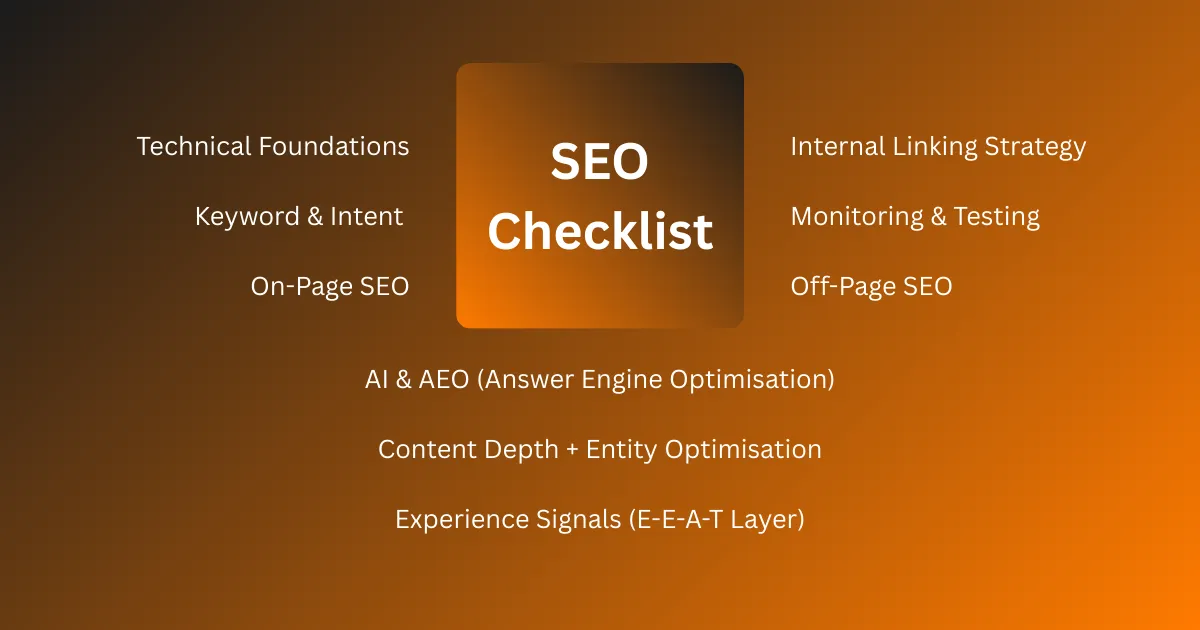
SEO Checklist Overview (AI-Era Edition)
Here’s the master framework I follow:
- Technical Foundations
- Keyword & Intent Architecture
- Content Depth + Entity Optimisation
- On-Page SEO Checklist
- Experience Signals (E-E-A-T Layer)
- Internal Linking Strategy
- Off-Page SEO & Authority
- AI & AEO (Answer Engine Optimisation)
- Monitoring, Testing & Continuous Improvement
Everything inside the post expands these steps.
Step 1 — Technical SEO Checklist (The Foundation Google Trusts)
Technical SEO accounts for almost 40% of ranking success in competitive niches. If Google can’t crawl, render, or understand your site, nothing else matters.
1.1 Crawlability and Indexing
Must-Do Checks
- Your robots.txt is clean and not blocking important pages.
- XML sitemaps auto-update and are submitted to Google Search Console.
- Ensure no accidental noindex tags on core pages.
- Use canonical tags to avoid duplicate content issues.
- Run a full crawl with tools like Screaming Frog, Sitebulb, or Ahrefs Site Audit.
Pro Tip from Real Projects:
I’ve seen multiple 6-figure websites lose rankings simply due to developer-added noindex tags after redesigns. Always check after a site update.
1.2 Speed & Core Web Vitals
Speed is a direct SEO ranking factor—and an indirect one for UX.
Checklist
- Largest Contentful Paint (LCP) under 2.5s.
- CLS score is stable with no layout shifts.
- Optimise images: WebP + lazy loading.
- Reduce unused JavaScript (critical for WordPress sites).
- Implement a CDN (Cloudflare recommended).
- Use server-side caching (LiteSpeed Cache or WP Rocket).
1.3 Mobile Optimisation
With Google’s mobile-first indexing, your site is judged primarily by its mobile performance.
Mobile SEO Checklist
- Responsive design across all screen sizes.
- Font sizes readable (16px minimum).
- Buttons & links are tap-friendly.
- Remove intrusive pop-ups on mobile.
Step 2 — Keyword Architecture & Search Intent
Most SEO failures come from poor keyword mapping.
The trick isn’t finding keywords—it’s mapping them properly across intent levels.
2.1 Keyword Categories to Cover
- Informational: “What is SEO?”, “ranking factors for seo”
- Commercial: “seo audit service”, “best seo agency”
- Transactional: “hire seo expert”, “seo packages”
- Navigational: “brand name + reviews”
Your checklist seo strategy should include all of these.
2.2 LSI Keywords & Semantic Expansion
Use NLP-related variations like below; all these keywords serve the same intent:
- Seo optimization checklist
- seo ranking factors
- seo best practices
- seo check tools
- technical seo checklist
- ecommerce seo checklist
These help Google understand topical depth.
Step 3 — Content Optimisation Checklist (Entity + AI Era)
Why Content Depth Matters More Than Ever
Google’s ranking systems (HCU, EEAT classifier, Panda, RankBrain, and now AI-evaluation layers) prioritise content that demonstrates:
- Deep topical authority
- Clear entities
- Expert-level insights
- Unique value
Cheap AI-generated content simply won’t rank.
3.1 Content Depth Checklist
Use the “EIC Framework” I apply in client campaigns:
E — Expertise
Add:
- First-hand experience
- Case studies
- Examples
- Screenshots
- Data
I — Intent
Address:
- What users want
- Why do they want it
- What action should they take?
C — Completeness
Cover:
- Pros & cons
- Alternatives
- Comparisons
- Common mistakes
- Step-by-step breakdowns
This is how you win snippets and AI Overview positions.
3.2 On-Page SEO Checklist
Core On-Page Ranking Factors
- Focus keyword in H1 (once)
- Include LSI keywords throughout the content.
- Optimize H2/H3 for semantic search
- Use short descriptive URLs
- Add schema (FAQ, HowTo, Article)
- Ensure the first 150 words mention the main keyword.
Step 4 — EEAT: The Trust Layer Google Now Cares About Most
Google’s documentation repeatedly emphasises Experience.
From real audits, pages with unique experience signals outperform generic content—even with fewer backlinks.
4.1 EEAT Checklist
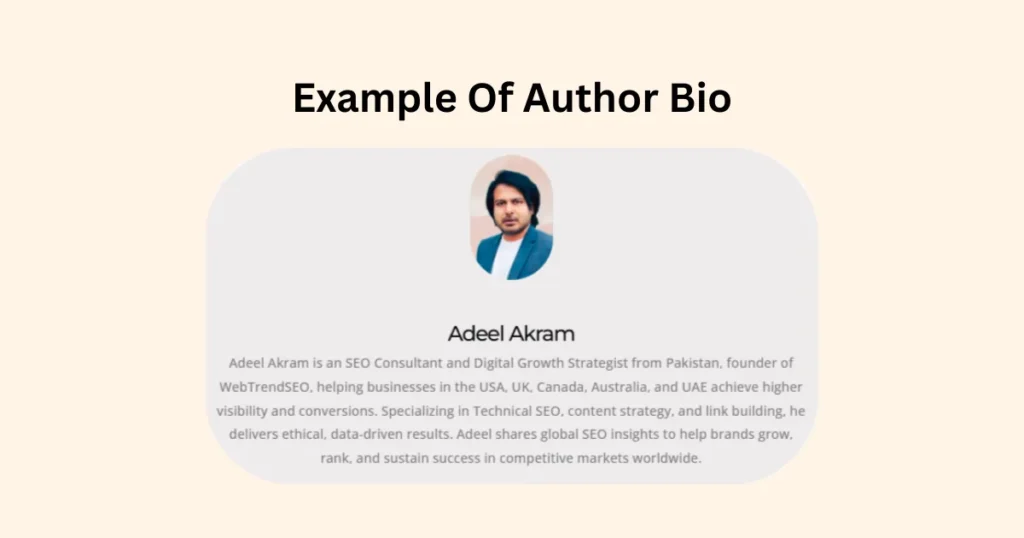
- Add author info with credentials.
- Add “Reviewed by” or editor information.
- Include case studies and client results.
- Show data from trusted sources (Pew, Statista, .gov, .edu)
- Add original screenshots, proofs, and processes.
.
Example:
For a medical client, adding doctor-verified review notes improved rankings by 27% in 60 days.
Step 5 — Internal Linking: The Most Underused SEO Weapon
Internal linking is the “secret SEO power-up” most websites ignore.
Think of it as giving Google a map of your expertise.
5.1 Internal Link Checklist
- 2–3 internal links per 500 words
- Link to parent & child pages (hub-and-spoke)
- Use descriptive anchors (avoid “click here”)
- Add “Topical clusters” for authority.
Step 6 — Off-Page SEO Checklist (Links, Mentions, Signals)
Backlinks are still a top 3 ranking factor—but relevance and quality matter more than quantity.
6.1 Authority Building Checklist
- Acquire niche-relevant links
- Secure local citations
- Earn brand mentions via PR
Optimise social profiles for consistency. - Build topical backlinks, not random guest posts.
6.2 Link Quality Criteria
A good link should come from a site with:
- Real traffic
- Topical alignment
- Authority and editorial trust
- Indexing history
- No spam signals
Bad links can get you penalised or filtered.
Step 7 — AI & AEO (Answer Engine Optimisation)
Search is shifting from “10 blue links” to AI answers on Google, Bing, Perplexity, ChatGPT, and You.com.
7.1 AEO Checklist
To rank in AI Overviews:
- Use concise answer-style paragraphs
- Add structured data (FAQ, HowTo, Speakable)
- Optimise for questions
- Include step-by-step instructions
- Provide factual, verifiable information.
Step 8 — SEO Monitoring & Continuous Optimisation
SEO is not a set-and-forget system.
I monitor over 40 points monthly for clients.
8.1 Monitoring SEO Checklist
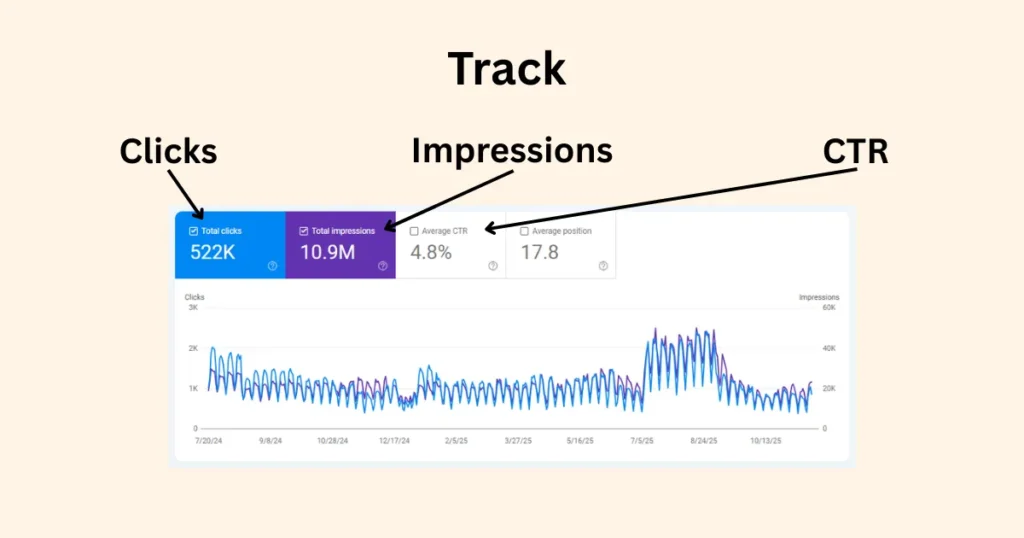
Track in Search Console:
- Impressions
- CTR
- Queries showing declining trends
- Crawl errors
- Page experience metrics
Track with GA4:
- Engagement time
- Conversions
- User flow
Track with tools:
- Ahrefs: Keywords, backlinks
- Screaming Frog: Technical health
- Surfer/NeuronWriter: Content depth
Comparison Table: Modern SEO Approaches
| SEO Method | Good For | Strength | Weakness |
| Traditional SEO | Basic ranking | Stable and safe | Slow results |
| AI-Enhanced SEO | New content | Fast creation | Risk of thin content |
| Entity SEO | Authority building | Topical depth | Requires expertise |
| EEAT-Driven SEO | YMYL niches | High trust | Needs proof & credibility |
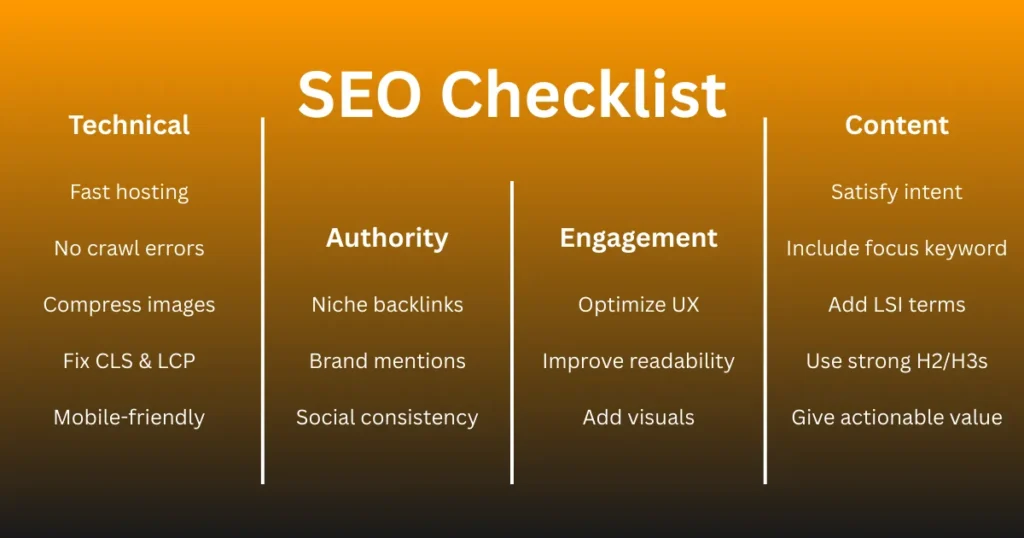
SEO Checklist (Simple Snapshot)
Technical
- Fast hosting
- No crawl errors
- Compress images
- Fix CLS & LCP
- Mobile-friendly
Content
- Satisfy intent
- Include focus keyword
- Add LSI terms
- Use strong H2/H3s
- Give actionable value
Authority
- Niche backlinks
- Brand mentions
- Social consistency
Engagement
- Optimize UX
- Improve readability
- Add visuals
FAQs (Voice-Search Optimised)
What is the SEO checklist used for?
A checklist SEO framework ensures your content meets all ranking factors—technical, on-page, authority, and experience—so your pages can rank higher and stay stable across Google updates.
What are the most important SEO ranking factors?
Crawlability, content relevance, EEAT signals, user experience, topical authority, and high-quality backlinks remain the core SEO ranking factors for consistent visibility.
How do I perform an SEO check on my website?
Use tools like Google Search Console, PageSpeed Insights, and Ahrefs Site Audit. Then, validate content quality, keywords, internal links, and technical performance manually for accuracy.
What is an SEO optimisation checklist?
An SEO checklist is a structured roadmap covering technical fixes, content optimisation, keyword targeting, internal linking, and authority-building steps required to improve rankings.
Conclusion
SEO success in 2026 requires more than keywords—it demands depth, credible experience, and a strategic checklist. By following this SEO checklist guide, you’ll set up a powerful foundation for ranking higher, earning trust, and generating real business results.
If you want a personalised audit or want me to optimise your SEO strategy step-by-step, I can help you build a full SEO plan tailored to your website.

Links will be automatically removed from comments.