AI & GEO

Robots.txt & AI Crawler Checker

See how robots.txt treats search, AI discovery, and model-training crawlers for a specific path.

Public URLs are fetched securely with strict crawl and rate limits. Reports are not saved to your WordPress database.
Review robots.txt availability, directives, sitemap declarations, and crawer-specific access without editing the file.

Robots.txt & AI Crawler Checker

Understand Which Crawlers a Path Allows

WebTrendSEO’s Robots.txt & AI Craler Checker fetches a public website’s robots.txt file and evaluates its rules for the path you specify.

Enter a website URL and a path such as / or /important-page/. The report checks robots.txt HTTP status and size, malformed directives, sitemap declarations, and access rules for 23 crawler tokens across 13 vendors.

Results separate search or indexing crawlers from model-training crawlers where applicable. Robots.txt expresses crawl preferences; it does not guarantee indexing, removal, citations, or compliance by every automated agent.

robots.txt HTTP Status

File Size Review

Malformed Directive Checks

Sitemap Declarations

Path-Specific Rule Matching

23 Crawler Tokens

13 Crawler Vendors

Search vs Training Access

Manual Configuration Review
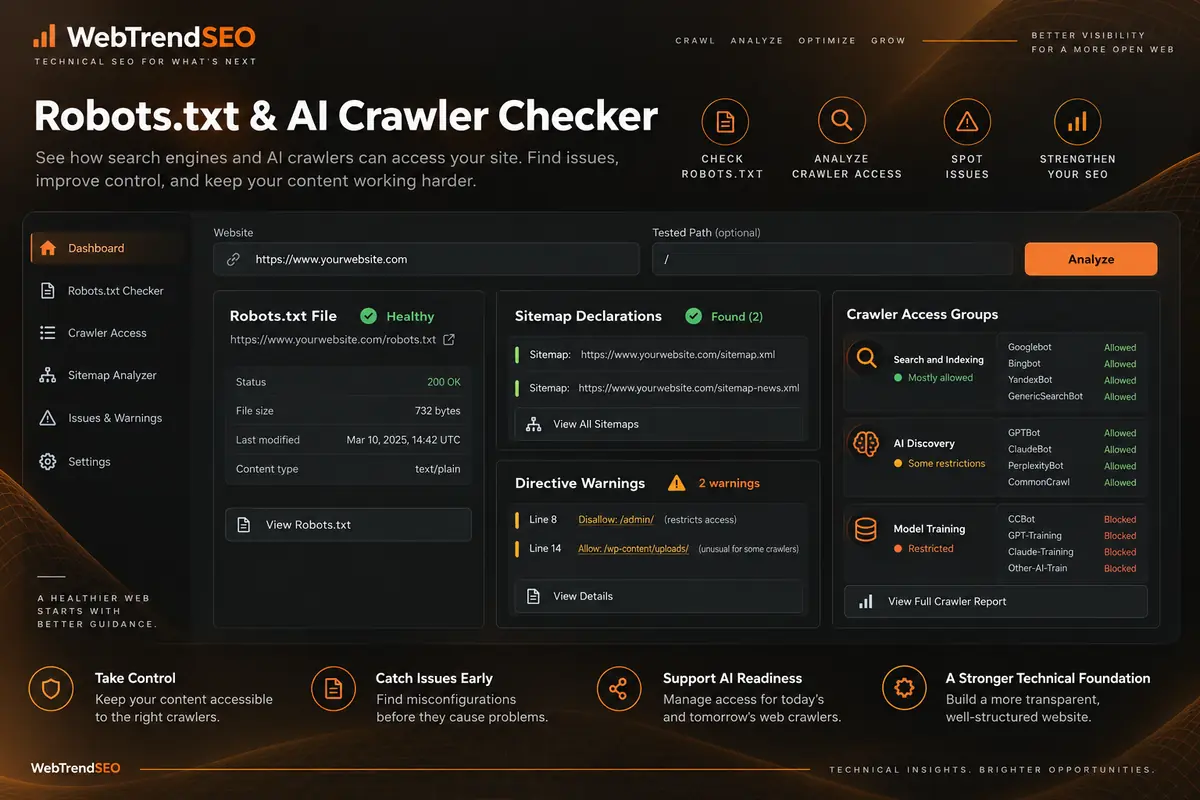
Robots.txt and AI crawler dashboard showing file health, sitemap declarations, directive warnings, and crawler access groups
HOW IT WORKS

How to Use the Robots.txt & AI Crawler Checker

Test the exact path you care about, hen compare crawler groups and verify the relevant directives in context.
Enter the Website URL

Add the public site whose robots.txt file you want to inspect.

Enter a Path to Test

Use / for the homepage or provide a specific public path.

Run the Access Check

Fetch robots.txt through the secure, rate-limited checker.

Review File Health

Check response status, file size, malformed directives, and sitemap entries.

Compare Crawler Access

Review search, AI discovery, and model-training crawler rules separately.

Confirm Before Editing

Validate the matched rule and test important changes after deployment.

WHY USE OUR ROBOTS.TXT & AI CRAWLER CHECKER?

Review Crawler Rules Without Reading Them Line by Line

A robots.txt file can contain overlapping user-agent groups, broad wildcards path-specific rules, and crawler names that serve different purposes. Small configuration mistakes can create unintended access restrictions.

This checker organizes the file into a path-specific report and separates search or indexing access from model-training controls. Use it to investigate configuration—not to predict rankings, indexing, or whether a service will cite your content.

For technical crawlability and indexing support, explore WebTrendSEO’s technical SEO services.
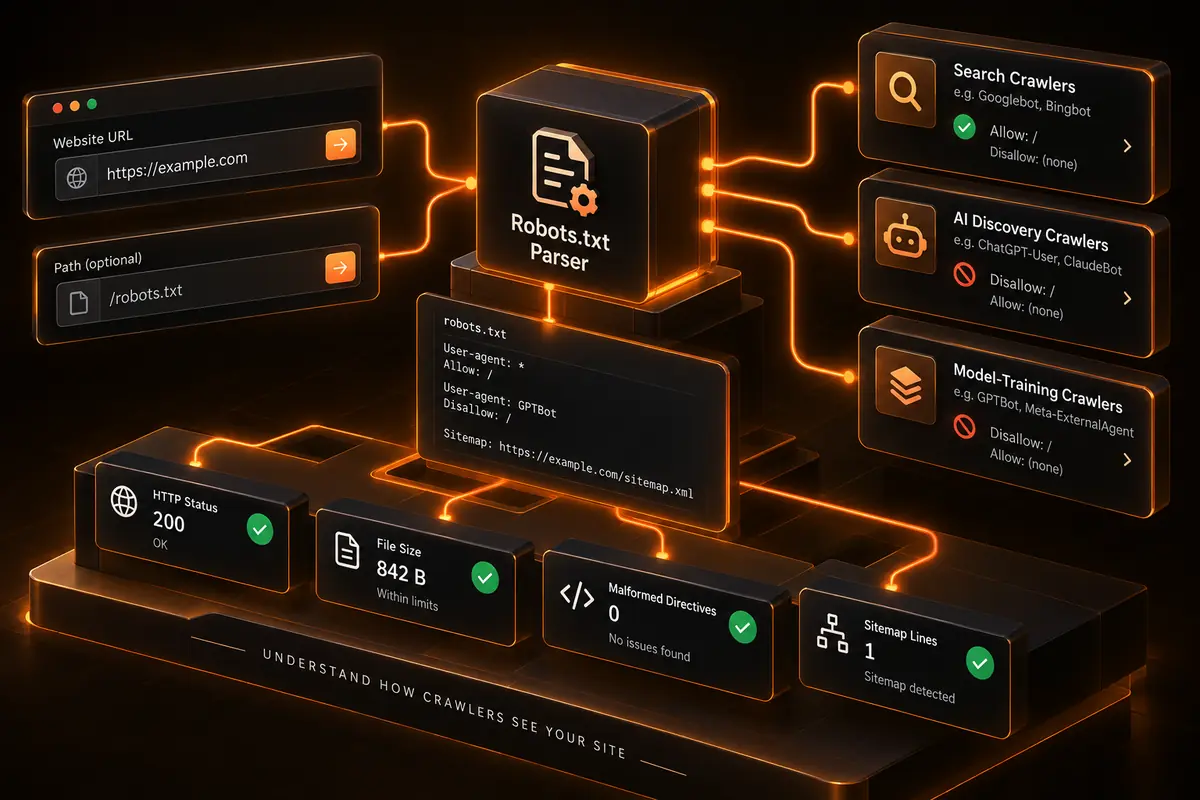
Website URL and path flowing through a robots.txt parser into search, AI discovery, and model-training access results

Path-Specific Rule Testing

Search and Training Separation

Major AI Crawler Coverage

Directive Health Checks

Sitemap Declaration Review

No Automatic File Changes

CHECK ACCESS BEFORE YOU CHANGE IT

Test Important Paths Against Crawler Rules

See which rules match a specific path, identify malformed directives, and reiew crawler groups before updating robots.txt.
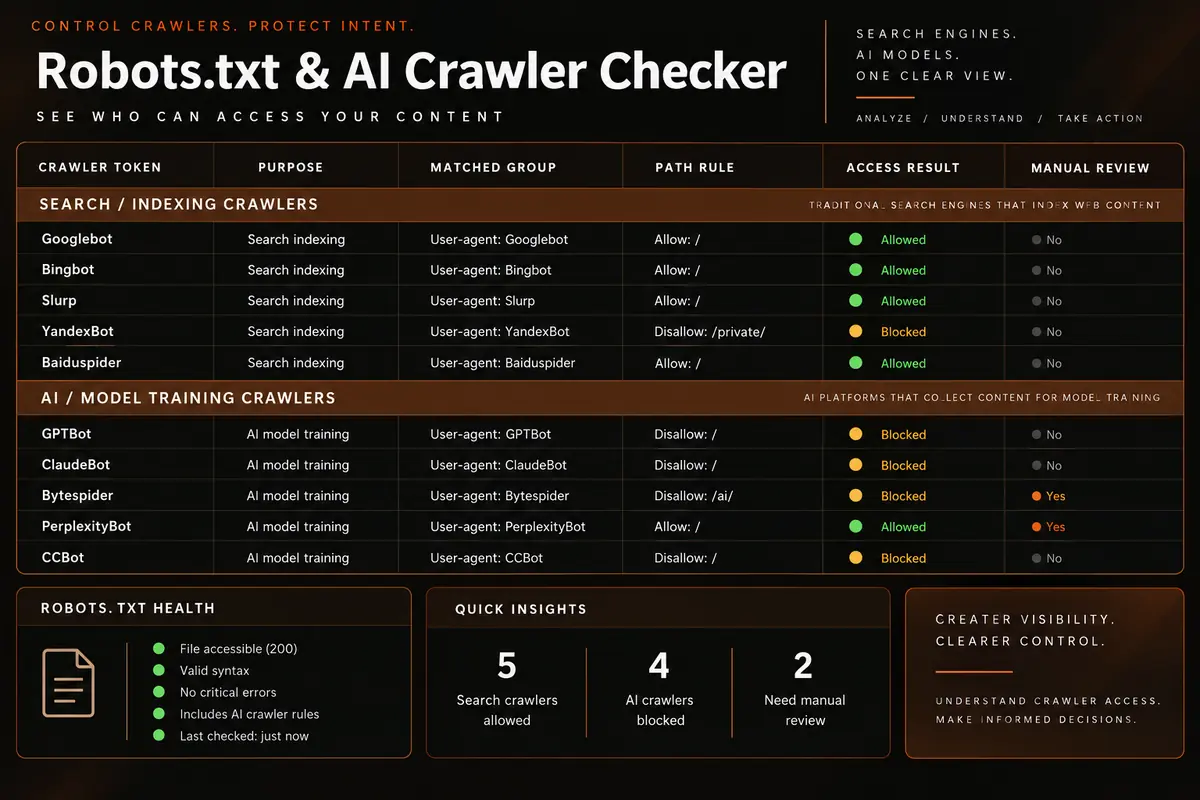
Crawler rules matrix comparing purpose, matched robots group, path rule, access result, and manual review
USE CASES

Who Can Use This Tool?

Use the checker during technical audits, migrations, AI crawler reviews, staing launches, or any investigation involving robots.txt access rules.
Technical SEO Specialists
Website Owners
Developers and DevOps Teams
AI Search and GEO Teams
Agencies Auditing Client Sites
Publishers Reviewing Training Access
Migration and Launch Teams
RESPONSIBLE PUBLIC CHECK

A Limited Review of Public robots.txt Rules

The tool fetches public URLs througha secure, rate-limited crawler and states that reports are not saved to the WordPress database.

Enter only public website addresses and paths. The checker does not require credentials and should not be used with private admin, staging, or customer-data URLs.
FREE TOOLS

Other Free Tools From WebTrendSEO

Robots.txt Generator

Create robots.txt access rules for careful review before implementation.

AI Crawler Analytics Checker

Analyze access logs for activity from identified AI crawlers.

LLMs.txt Generator

Generate an llms.txt file from your site information.

Indexability Checker

Check robots directives, canonical signals, and indexing restrictions.

XML Sitemap Generator

Generate an XML sitemap from a supplied URL list.

Sitemap Health Checker

Review XML sitemaps for errors and duplicate URLs.

Clear crawler policies begin with valid directives, precise paths, and an informed review. Built by WebTrendSEO.

FAQS

Robots.txt & AI Crawler Checker FAQs

Learn how path-specific robots.txt rules affect different crawler groups and what the report cannot guarantee.
It fetches a public robots.txt file and explains which rules apply to a path for search, AI discovery, and model-training crawler tokens. It also reports file status, size, malformed directives, and sitemap declarations.
Enter a website URL and a path to test. The tool retrieves robots.txt, parse its user-agent groups and allow or disallow rules, then applies the most relevant rules to supported crawler tokens.
The interface reports 23 crawler tokns across 13 vendors, including services associated with OpenAI, Anthropic, Perplexity, Google, Meta, Amazon, Apple, Common Crawl, and others. Coverage reflects the crawler list built into the current tool.
Not necessarily. A vendor may use different crawler tokens for search, AI dicovery, and model training. Review each user agent separately; a rule for one token does not automatically apply to every service from that company.
Robots.txt controls requested crawl ccess but does not guarantee deindexing, removal from existing datasets, rankings, AI citations, or crawler compliance. The report tests the path and rules available at the time of the request.
No. It does not change directives, ad sitemap lines, block bots, or update your server. Review the matched rules, edit robots.txt through your CMS or hosting workflow, and retest carefully.
LET’S TALK

Turn Crawler Rules Into a Clear Technical SEO Policy

A path-level check can reveal confusng or conflicting directives. WebTrendSEO can help review robots.txt, crawlability, indexation signals, sitemaps, and AI crawler policies within a broader technical SEO strategy.