WebTrendSEO Search Console Intelligence

GSC Content Decay Finder

Find pages with sustained organic decline, separate true decay from seasonality and lower search demand, estimate lost clicks, and build a data-backed refresh queue.

Read-only GSC access Up to 16 months Cause-based refresh actions
Step 1

Load monthly page performance

The direct GSC connection retrieves page-level data for each complete calendar month, which is required for reliable decay detection.

Recommended

Connect Google Search Console

Fetch monthly page metrics with temporary browser authorization. Tokens and performance rows are not saved in WordPress.

A normal one-click GSC ZIP contains a sitewide chart and a page-total file, but not page-by-month rows. Direct connection is recommended. Compatible API, Looker Studio and custom exports are supported.

Explore a realistic decay report

Load 12 months of sample data to test scoring, trend diagnosis, directory rollups, filtering, exports and refresh briefs.

Privacy-first: Direct Search Console rows and OAuth tokens remain in the visitor’s browser. Optional page auditing sends only selected public URLs to this WordPress site to read status, title, H1, canonical, robots, word count and visible freshness dates.

Identify declining content and prioritize a refresh using your own search performance.

GSC CONTENT DECAY FINDER

Find pages losing clicks over time

WebTrendSEO’s GSC Content Decay Finder helps you find pages whose search performance has weakened over time. Connect Search Console temporarily or upload a CSV or ZIP export of monthly performance.

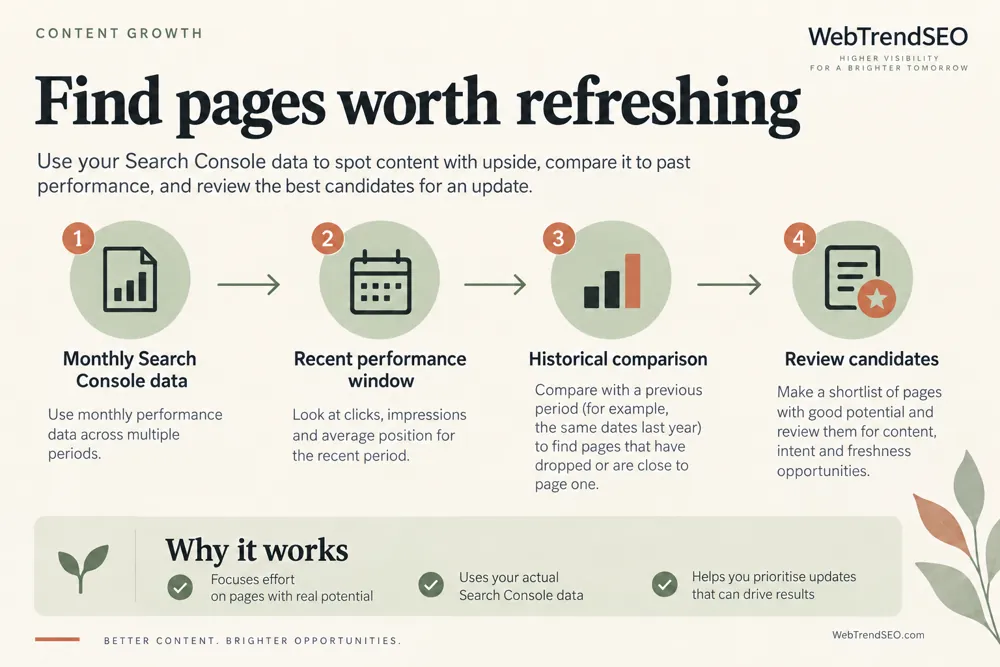
Compare the latest one, two, or three months with a selected baseline: the best month or the best two or three-month average. Set minimum baseline clicks and a decline threshold to focus the review.

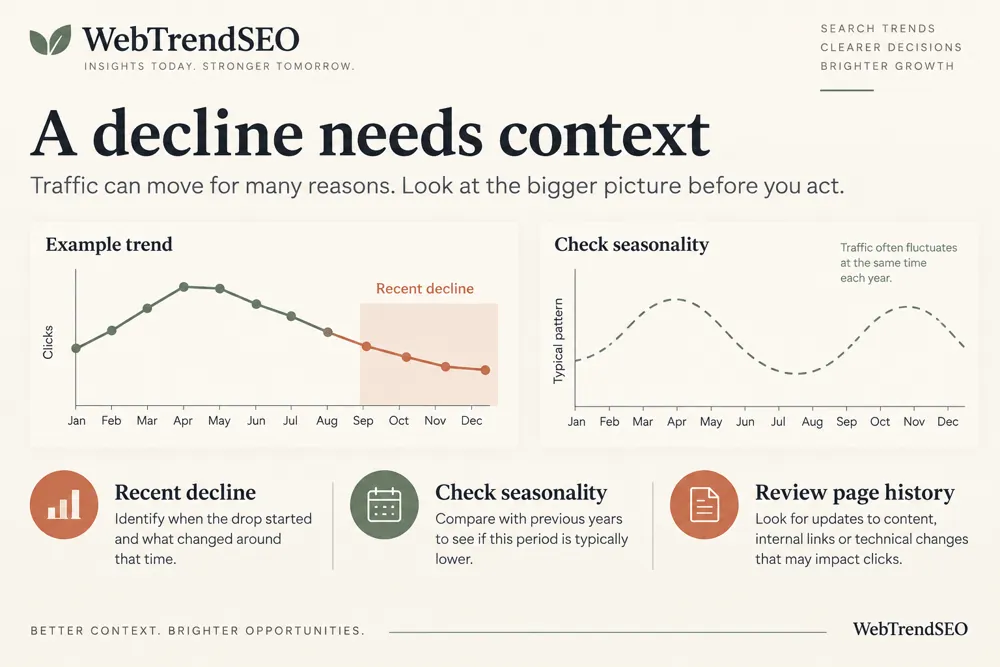
Use the year-over-year seasonality guard, exclusion patterns, and sustained decline signals to reduce noise. The findings identify candidates for investigation; they do not prove that outdated content caused the loss.

Monthly Search Console data

CSV or ZIP uploads

Recent one to three-month averages

Flexible best-period baselines

Minimum baseline clicks

Adjustable decline thresholds

Year-over-year seasonality guard

URL exclusion patterns

Optional public-page audits
Content decay analysis workflow and practical review steps
How It Works

How to identify content decay

Use enough monthly history to make the comparison meaningful. Check the baseline and seasonal context before deciding which pages deserve an update.

Connect Search Console or upload monthly performance data
Choose the recent averaging window
Select a best-period baseline
Set click and decline thresholds
Review seasonality and exclusion settings
Investigate declining pages and plan updates
WHY USE THIS CHECKER

Prioritize updates using monthly search performance

A page can decline gradually without creating an obvious site-wide alarm. Monthly comparisons help you find those losses before choosing where to spend editorial time.

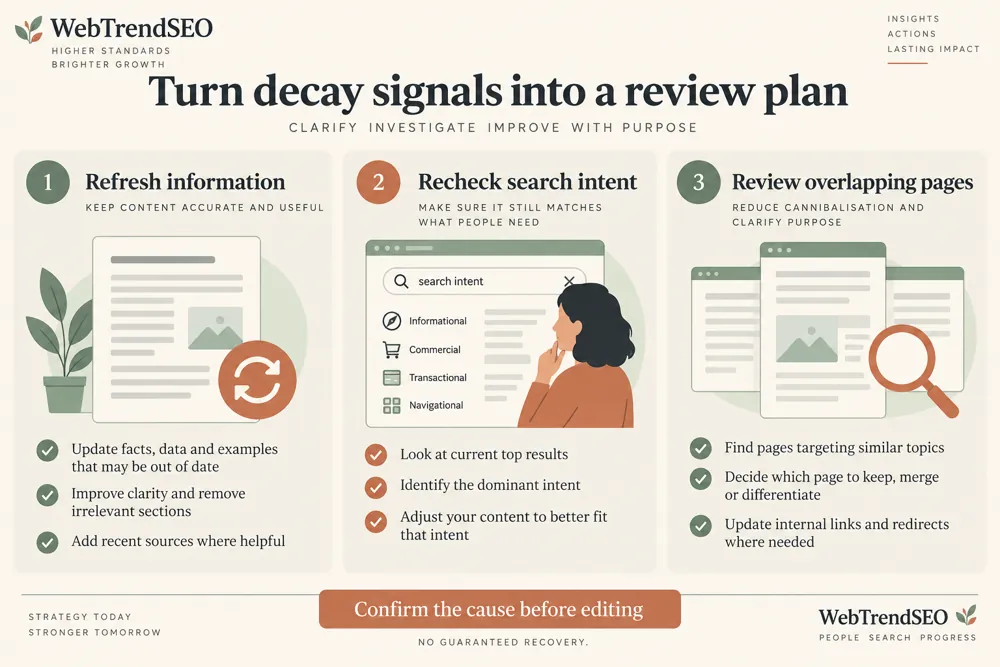
Review the topic, search demand, competitors, technical changes, and page usefulness alongside the report. A refresh should solve a real gap rather than simply change the date or add more words.

Content decay analysis signals and findings illustrated

Find sustained performance declines

Compare against a stronger past period

Reduce small-sample noise

Keep seasonal changes in context

Prioritize content investigations

Measure updates against a recorded baseline

NEED HELP REFRESHING CONTENT?

Build a measured content refresh plan

Turn the strongest decay candidates into a focused update plan. Record the evidence, choose a specific improvement, and compare performance again after the change.

Content decay analysis use cases for website owners and SEO teams
Use Cases

Who Can Use This Tool?

Use the tool for established articles, guides, category pages, and other content with enough monthly performance history. New pages may need more time before a decay comparison is meaningful.

Editors planning article refreshes
SEO teams monitoring established pages
Agencies prioritizing content updates
Site owners reviewing older guides
Store teams reviewing category content
Publishers tracking gradual declines
Marketing teams measuring refresh results
Safe & Secure

Your performance data and privacy

Search Console tokens and performance rows remain in your browser and are not saved to the WordPress database.

If you choose an optional public-page audit, selected URLs are sent to the server to fetch page metadata. Submit only public URLs without sensitive access tokens.

Free Tools

Other Free Tools From WebTrendSEO

SEO Traffic Drop Diagnosis

Compare Search Console periods to investigate traffic drops.

Content Pruning Recommendation Tool

Review underperforming pages for content updates or page consolidation.

Content Brief Topical Gap Generator

Plan a content brief and review topical gaps.

Keyword Cannibalization Checker

Find pages competing for identical queries using Search Console.

Internal Link & Orphan Page Checker

Compare link and URL inventories to find orphan-page candidates.

CTR Opportunity Finder

Find low-CTR opportunities in Search Console performance data.

Practical SEO tools from WebTrendSEO

CONTENT DECAY FAQ

Content decay questions answered

Learn how monthly comparisons work, how to account for seasonality, and what to review before updating a page.

It compares recent average clicks with a stronger historical baseline using monthly Search Console performance. Declining pages become candidates for a closer content and SEO review.

You can use the best month or the average of the best two or three months. The recent comparison can use one, two, or three months. Review the period before interpreting a decline.

Yes. Upload a CSV or ZIP export with monthly performance data, or use the temporary read-only Search Console connection.

The year-over-year guard adds seasonal context where suitable history is available. It helps you review recurring patterns, but you should still check demand and other changes.

No. Demand, competition, technical changes, and search-result changes can also affect clicks. Review those factors before choosing a content update.

Yes. Selected public URLs are sent to the server to fetch page metadata. Search Console tokens and performance rows remain in your browser and are not saved to WordPress.

REVIEW YOUR DECLINING PAGES

Find content that needs a fresh review

Compare your monthly performance and find the strongest decline candidates. Review the page’s purpose and search context before planning a focused refresh.